

Spellbrand Blog
The B2B Software Naming Crisis: Why Every SaaS Company Sounds Exactly the Same
Open a new tab. Go to Product Hunt. Scroll for ten minutes.
Try to remember, without looking back, the names of five B2B software companies you just saw. Not the taglines. Not the logos. The names.
You probably cannot. I cannot either, and I do this for a living.
This is the B2B software naming crisis, and it is worse in 2026 than it has ever been. Hundreds of companies launching every week with names that blur into a single blob of vowel-heavy, suffix-padded, metaphor-starved sounds. Flowly. Fluxo. Synthara. Parallelix. Cogniverse. Stackably. Every one of them sounds like a company. None of them sound like this company.
After naming 250+ brands since 1998, including dozens of B2B software clients, we have watched this collapse happen in slow motion. Today I want to explain how it happened, why it matters more than most founders realize, and what actually works when you refuse to blend in.
What the B2B naming crisis actually looks like
Here is the pattern you are seeing without consciously noticing it. Modern B2B software names almost all belong to one of five exhausted archetypes:
-
The Latin-ish invention. Names that sound vaguely scientific but mean nothing in any real language. Cogniva, Lucida, Synthara, Visera. They feel serious. They communicate nothing. They are indistinguishable from fifty other names using the same phonetic playbook.
-
The verb plus -ify or -ly. Notify, Simplify, Clarify, Shippo, Tasky, Flowly, Bitly, Calendly. A trend that started with Spotify and ended with a hundred thousand startups wearing the same uniform. We covered this pattern in our post on brand naming mistakes to avoid. The pattern is dead, but nobody told the founders.
-
The physics or chemistry reference. Quantum, Kinetic, Catalyst, Momentum, Vector, Fusion, Axiom. These words had real meaning once. Now they are decorative. When every third SaaS company is called something-Quantum, the word stops signaling anything except “founder read a physics textbook in college.”
-
The AI-adjacent suffix. -AI, Neur-, Cogni-, Synth-, Brain-. Every AI startup in 2026 has smashed these morphemes together hoping one sticks. The result is a category where every company sounds like a sequel to every other company.
-
The two-word compound. Data plus Bridge. Smart plus Sheet. Flow plus Hub. Cloud plus Desk. These names are easy to generate, trivial to understand, and completely impossible to remember because they describe instead of distinguish.
Look at your own shortlist. If it fits inside these five buckets, you are not naming a brand. You are picking a team jersey. If your shortlist is genuinely strong and you are just stuck choosing between the finalists, our final three decision framework is built for exactly that moment.
How we got here
The B2B naming crisis is not an accident. It is the predictable result of three forces that have been compounding for a decade.
Force one: the descriptive instinct
B2B founders are trained to be clear. Their investors demand clarity. Their engineers value precision. So when it comes time to name the company, the instinct is to describe what the product does.
The problem is that description is the enemy of distinction. A name that describes your category sounds like every other company in your category. “CloudDesk” tells the customer you are a cloud-based helpdesk. So do CloudHelp, HelpCloud, DeskCloud, and the fourteen other variations already in the market.
We wrote about this exact trap in brand name ideas by industry. The root cause is that founders name for what the product does instead of how the buyer feels. The strongest B2B brands refuse to describe what they do. Slack does not sound like project messaging. Stripe does not sound like payments. Datadog does not sound like observability. None of them are descriptive. All of them are unforgettable.
Force two: domain scarcity
The pool of available .com domains has been exhausted for years. When a founder finds a “clean” descriptive name, it is already taken. Rather than invest in a proper naming process, they reach for the next closest available domain. That is how you end up with getflow.com, tryflow.com, useflow.com, and flow.ai all existing at the same time, all competing for the same branded search term, all diluting each other.
Domain scarcity pushes founders toward invented names, but without a strategic framework, invented names become word salad. We cover the right way to handle this problem in our domain name strategy guide.
Force three: speed worship
B2B software culture treats naming as a ten-minute decision. You need a domain to launch the landing page, so you pick the first available one that does not sound embarrassing, and you move on. The naming decision gets slotted between choosing a Stripe account and picking a Notion template.
I’m genuinely sympathetic to the urgency. I have argued in your brand name does not matter as much as you think that speed to market often beats name perfection. But speed should not mean carelessness. A ten-minute naming decision does not become a ten-year brand asset. It becomes a ten-year tax you pay every time a customer cannot remember who you are.
Why this matters more in B2B than anywhere else
Consumer brands can overcome a weak name with sheer marketing spend. Show a forgettable name in a TV ad often enough and eventually it sticks. B2B brands do not have that luxury. The economics are different.
B2B buyers are scarce, expensive to reach, and highly deliberate. Every sales conversation costs real money. Every marketing impression is expensive. Every demo takes an hour of human time. When your brand name fails to stick, you pay for the failure in concrete line items:
- Higher cost per qualified lead because people cannot recall your brand when they are ready to buy
- Longer sales cycles because the prospect forgets your company between the first touch and the second
- Lower referral volume because happy customers cannot spell your name when recommending you to a peer
- Weaker inbound because your branded search volume is diluted by competitors using similar sounds
The hidden ROI of a great brand name is most dramatic in B2B, where a single remembered recommendation can be worth $50,000 in lifetime contract value. A forgettable name does not just feel underwhelming. It leaks revenue at every stage of the funnel.
The B2B naming paradox
Here is the paradox every B2B founder eventually hits. The names that feel safe in the boardroom are the names that fail in the market. The names that feel risky in the boardroom are the names that win.
When we present naming options to B2B clients, the most distinctive candidates almost always trigger the same response: “That does not sound like a software company.” And that is exactly why it works. That reaction, the slight discomfort of a name that breaks category conventions, is the strongest signal a name can generate.
Think about the strongest B2B brand names of the last twenty years. Slack. Notion. Figma. Stripe. Intercom. Zendesk. Asana. Airtable. Zapier. Every one of them sounded wrong the first time you heard it. Slack sounds like slacking off. Figma sounds like a Pokemon. Zapier sounds like a mosquito zapper. None of them sound like “serious enterprise software.”
And yet these are the companies that built billion-dollar brands. Because in a sea of names that all sound like software, a name that does not sound like software is the one that gets remembered.
Free Download
Brand Consistency Checklist
A 27-point checklist to audit your brand across every touchpoint. Used by our team on real client projects.
Success! Check your email for the download link.
Instant PDF download. We'll also send branding tips -- unsubscribe anytime.
What actually works in B2B naming
After decades of naming technology companies, here is the framework we use when a B2B founder wants to escape the sameness trap.
Lead with sound, not meaning
The most memorable B2B names are memorable because of how they sound, not because of what they describe. Strong phonetic structure is the single best predictor of recall. The psychology behind brand names shows that brands with distinctive sound patterns, especially those using plosive consonants (K, T, P, B, D, G) and short vowel structures, are measurably easier to remember than names built around flowing, vowel-heavy structures.
Stripe has a hard T. Slack has a hard K. Figma has a hard G. Zoom has a hard Z. These names are not accidents. They are engineered to stick.
Choose a concept, not a category
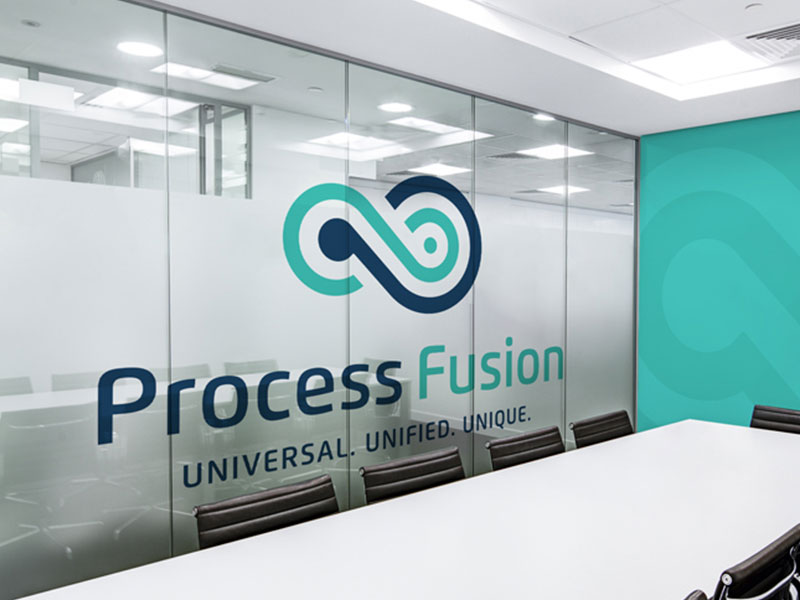
A category name ages the moment your product evolves. A concept name grows with you. When we named Process Fusion, a digital transformation software company, we did not pick a name that described workflows or data pipelines. We picked a name that captured a concept: the idea that fragmented processes can become unified. That concept works today, and it will still work when the product line doubles in five years.
Contrast that with “WorkflowHub.” The moment the product adds anything beyond workflows, the name is a cage. You spend the rest of your company’s life either apologizing for the name or paying to rebrand it. We covered this trap in depth in our guide to the real cost of logo design and rebranding.
Resist the AI suffix
I know. Every B2B software company in 2026 is an AI company. I understand the temptation to bake AI into the name. Do not.
In five years, AI will be as baseline as the internet. Calling your company “SomethingAI” today is like calling your company “SomethingDotCom” in 2001. It dates you instantly, and it buries you in a category where a thousand other companies are making the exact same move. We wrote about this pattern in our breakdown of the difference between naming agencies, DIY, and AI tools, and the dated-suffix problem is one of the most common failure modes.
The companies that will dominate the AI era will not have AI in their names. They will have names that sound like category leaders. Names that could belong to the next thirty years of technology, not just the current trend cycle.
Check trademark clearance before falling in love
Half of the B2B naming disasters I see happen because founders committed emotionally before checking legal availability. They built a landing page, printed business cards, shipped a beta, and then discovered the name was trademarked by a German enterprise software vendor they had never heard of.
Trademark screening is not an afterthought. In B2B, where international markets often define the real growth opportunity, trademark issues can shut down an entire expansion plan. Run the clearance before the name enters your shortlist, not after.
Test for the “phone call” moment
Here is a test I give every B2B client. Imagine a customer on a sales call, trying to refer you to a colleague. They say: “You should talk to the team at…”
Can they finish the sentence?
If the name requires spelling, explanation, or a “you know, the one that…” qualifier, it is failing the phone test. In B2B, where referrals and word-of-mouth drive a massive portion of pipeline, a name that does not survive spoken transmission is a name that actively loses you deals.
The ten-year test
Before committing to any B2B name, run it through what I call the ten-year test. Five questions. Be honest.
- Will this name still feel fresh in 2036, or will it scream “2026”?
- Can our product expand into adjacent categories without the name becoming a cage?
- Will this name still work if we open European and Asian offices?
- Does the name sound like a company or a feature?
- If we were acquired tomorrow, would the name survive or get replaced?
If you cannot answer “yes” to at least four of these, your shortlist needs more work. The cost of getting this right is trivial compared to the cost of living with a weak B2B name for a decade. We broke down the full math in our brand investment ROI guide and the $100K brand vs $5K brand comparison.
What B2B founders ask that they should not
When founders come to us for B2B brand naming, certain questions come up over and over. Most of them are the wrong questions.
“What will make us sound more enterprise?” Usually the answer is nothing. Enterprise credibility comes from case studies, customer logos, and sales execution, not from the name. Chasing “enterprise-sounding” names is what drags founders into the Latin-ish invention bucket.
“Can we work ‘AI’ or ‘data’ or ‘cloud’ into the name?” You can, but you should not. Those words are the opposite of distinctive. They are signaling flags that your brand is one of many, not the one.
“What do our competitors’ names sound like?” Ask this question for one reason only: to ensure you sound different from them. The worst thing you can do is study your competitors’ names and then pick something that rhymes with them.
“Will customers understand what we do from the name alone?” They do not need to. Your homepage, your pitch, your product, and your marketing exist to explain what you do. The name exists to be memorable and ownable. Those are two different jobs and conflating them is how you end up with “CloudDeskFlow” instead of “Slack.”
The right questions are the ones we covered in our brand naming strategies that actually work: Which naming strategy fits our business stage and ambition? Which name will survive our next ten years of growth? Which name will investors, customers, and employees all be able to remember and repeat?
The real cost of blending in
Let me put this in numbers a B2B CFO would respect.
Imagine two identical SaaS companies launching in the same month with the same product, same team, and same go-to-market budget. Company A picks a name in ten minutes using a domain availability tool. Company B invests in a structured naming process and lands on a distinctive, memorable, ownable name.
Over the first three years, here is the likely gap:
- Company A pays 15-30% more per qualified lead because branded search is diluted and recall is lower
- Company A sees referral volume roughly half of Company B because the name does not survive word-of-mouth transmission
- Company A’s sales cycles run noticeably longer because prospects forget the company between touches
- Company A spends the equivalent of a full marketing headcount every year making up for what the name fails to do on its own
Multiply those gaps over three years of revenue and the cost of cheap naming looks less like a saving and more like a slow bleed. The hidden ROI of a great brand name is not marketing theater. It is the difference between a company that compounds and a company that leaks.
The path out of sameness
If you are leading a B2B software company and this article is uncomfortable to read, good. That discomfort is the signal that something in your name is working against you rather than for you.
Here is the path out, in order:
-
Audit your current name honestly. Use our free brand name scorecard to get a structured view of how your name performs against memorability, distinctiveness, pronounceability, and strategic fit.
-
Decide whether to fix or replace. A name with a low score might be rescuable with better messaging and identity. A name with a critically low score probably needs a rename. Our guide on when to rename your brand walks through the decision.
-
Invest at the right level. You do not need to spend $50,000. You need to spend enough to get a structured process, trademark clearance, and a name that survives the ten-year test. Our brand naming packages are designed to deliver maximum ROI at every business stage.
-
Commit and deploy. Once you have a name, stop second-guessing it. The strongest B2B brands are not the ones with the cleverest names. They are the ones that committed to their names and defended them consistently for years. We covered this pattern in the brands that survive their first year.
The bottom line
The B2B software naming crisis is real, and it is getting worse. Founders are reaching for the same tired templates, landing on the same forgettable sounds, and paying the same invisible tax on every line of their funnel.
The way out is not to follow the crowd more carefully. It is to refuse the crowd entirely. Pick a name that sounds wrong to your board and right to your future customers. Engineer it for sound, not description. Build it to survive ten years, not ten minutes of Product Hunt scrolling.
That is how you escape the sameness. That is how you build a B2B brand with a name worth remembering.
Wondering where your B2B brand name stands? Score your brand name for free, explore 250+ names we have created, or get in touch to discuss what a stronger B2B name could do for your pipeline.
Related Services You Might Love
Based on what you just read, here are services that can help you achieve similar results for your brand.

Mash Bonigala
Creative Director & Brand Strategist
With 25+ years of building brands all around the world, Mash brings a keen insight and strategic thought process to the science of brand building. He has created brand strategies and competitive positioning stories that translate into powerful and stunning visual identities for all sizes of companies.
Featured Work
See Our Work in Action
Real brands, real results. Explore how we've helped businesses transform their identity.

Client Love
What Our Clients Say
Don't just take our word for it. Hear from the brands we've worked with.

Tom McGee
PD Campus
"We tried several designers to design our logo and could not find the one that fit our company. After a few years of searching for a good branding company, I found Spellbrand through a random search. Spellbrand was sensational! They took the time to listen to our story and created a few designs that spoke to our team and what we do. We've never had a designer do that. We not only received a great logo, but we now have a brand we are all proud to wear! Thank you!"

Liana Alexander Raye
Harlequin Starr International Styles
"Working with the Spellbrand team has been incredibly easy. Mash has a team of experts who are extremely visionary and pioneering, pulling together ideas and initial thoughts into an actual brand giving you options that you feel best align with your thought process. I have no idea how they created my brand based on the vague brief I gave them, but they have worked wonders and magic. Their design, attention to detail, willingness to ensure the final product is exceptional all counts towards a company who has the client at the forefront of mind at every step of the way. Spellbrand is my Number 1 go to for all branding, website and design concepts moving forward. I look at them as an extension to our marketing arm. Just brilliant."
Related Services You Might Love
Based on what you just read, here are services that can help you achieve similar results for your brand.
Free Download
Brand Consistency Checklist
A 27-point checklist to audit your brand across every touchpoint. Used by our team on real client projects.
Success! Check your email for the download link.
Instant PDF download. We'll also send branding tips -- unsubscribe anytime.
Keep Reading
Related Articles
Apr 16, 2026
The Brand Name Moat: How the Right Name Creates an Unfair Advantage Your Competitors Can Never Copy
Your product can be copied in six months. Your price can be undercut tomorrow. But your brand name, if you chose it right, is the one competitive asset that's permanently yours. Here's how naming creates a moat that widens every year.
Read MoreApr 15, 2026
The Final Three: How to Pick Between Your Last Brand Name Candidates Without Blowing the Decision
You've narrowed it to three names. You can't decide. Every name has a flaw, every name has a fan on your team, and the launch date is closing in. Here's the decision framework I've used for 250+ naming projects to cut through the deadlock and pick the right name with confidence.
Read MoreApr 7, 2026
How to Name a Brand That Investors Take Seriously
Your brand name is your first pitch. After naming brands that have collectively raised over $50M in funding, this is how the name influences investor perception and what founders get wrong.
Read More