

Spellbrand Blog
3 Steps To A Winning Sales Process

Every business has a sales process. Some have it documented and some don’t. In any case, determining how effective your sales process is should be a constant undertaking to ensure you are building a strong brand.
In this article, I offer you 3 steps to a winning sales process.
A sales process is simply a series of steps that your brand follows to guide prospects from coming into contact with your brand right through a sale. This process begins with the prospect identifying a need for your product or service (or sometimes your brand proactively educating the prospect on such a need) and following the buyer’s journey – making sure your brand and positioning strategy funnels the prospect towards becoming your customer.
In this article we discuss how to document a sales process that explains each step your prospect should take, the knowledge the buyer needs at each step to move forward in the funnel, the education your brand should provide at each step and how to convert the prospect into a customer.

Why document your sales process?
A business runs successfully when there are business systems in place and those systems are carefully documented. Small businesses, especially, tend not to have documented system. This may be because business systems are considered “behind the scenes” activities and unlike brand and marketing strategies or sales campaigns, good business systems are considered boring.
Here are some reasons why you should document your sales process:
[mk_dropcaps style=”fancy-style”]S[/mk_dropcaps]ell more effectively – A document sales process will help you or your sales team to sell more effectively. Instead of ad hoc decisions, you will be armed with a tried and tested series of steps that would result in success.
[mk_dropcaps style=”fancy-style”]G[/mk_dropcaps]enerate more accurate sales and revenue reports – Reports are basis of any successful sales campaign. Understanding what is happening with your sales gives you an insight into how to tweak your sales process and your campaigns.
[mk_dropcaps style=”fancy-style”]I[/mk_dropcaps]dentify which stages have bottlenecks – By documenting your sales process and analysing sales campaigns and sales reports, you can identify where your prospects are taking the longest to move forward and perhaps even dropping off the funnel completely.
[mk_dropcaps style=”fancy-style”]M[/mk_dropcaps]inimize the amount of time it takes for estimates and forecasts – Estimates and forecasts are very crucial in any sales campaign and having a document sales process makes it easier, faster and more accurate to create these forecasts.
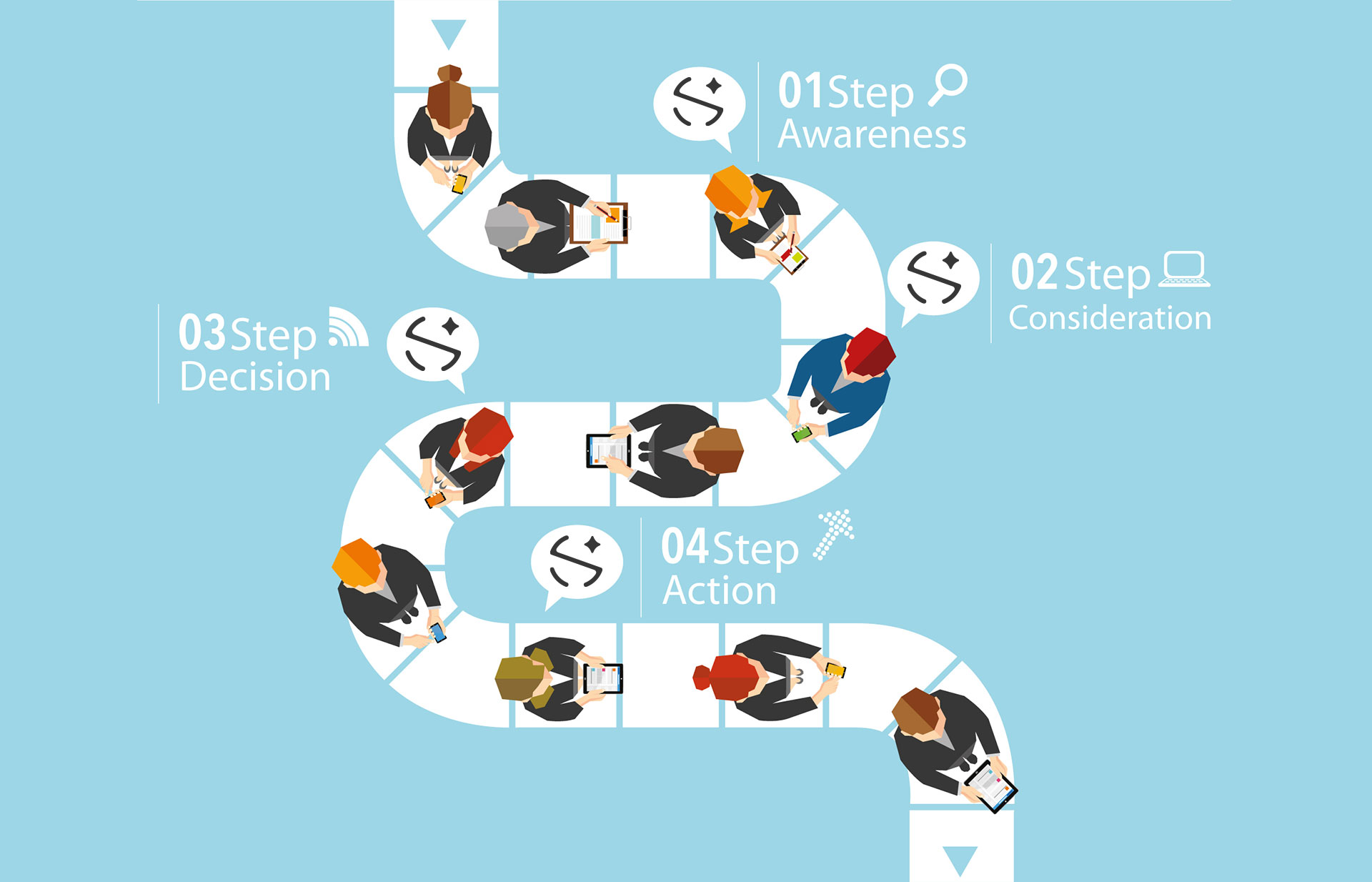
Match your sales process steps to your buyer’s journey steps
By starting with understanding your buyer’s journey, you can then work towards matching the various steps of your sales funnel to the steps that your buyer naturally takes towards a purchase.
A misalignment of your sales process steps to those of the buyer’s journey is the single most critical cause of failure of sales campaigns. Businesses tend to aggressively invest in their sales campaigns with out really paying attention to this crucial concept and end up wasting time, resources and money.
As yourself these questions to help you determine if your sales process is aligned to the buyer’s journey:
- Do you really understand your buyers goals?
- Do you have metrics that show you how many prospects are at each step and how many are really moving forward?
- Do you understand how conversion is happening and which steps are contributing the most?
- Are you educating your prospects during the awareness stage – not on your product or service but rather topics related to the solving the problem they have?
- Are you educating your prospects during the consideration stage by offering a structured solution to the problem which includes your product or service?
- Is your sales funnel equipped to properly guide the prospect in the decision stage by creating trust?

Step 1: Define your prospect’s buying process
List the steps that your prospect takes in each of the main stages of the buyer’s journey – awareness, consideration, and decision stages.
Let us first list the potential steps your prospect may go through:
- Feeling a pain point – the prospect feels a pain that may be resolved through your product or service
- Researching solutions – the prospect starts looking around for a solution to their pain
- Identifying potential solutions – the prospect has identified a few potential solutions to their problems – i.e a few vendors or businesses that supply the solution
- Considering possible vendors – the prospect has shortlisted a few vendors and is moving into deciding which ones they would like to give their business to
- Final decision and purchase – the prospect has selected the business they want to give their money to
For each of these steps, next list the following:
- What information does the prospect need in each step
- Content and material that your prospect needs to exposed to in each step
- Time the prospect needs to spend in each step

Step 2: Identify sales tools for each step
Once you have defined the sales stepson what your prospect needs to know in that step, you will have to create sales tools that give that knowledge to your prospect to help them move forward in their journey.
Each sales tool at each step should only give sufficient information to your prospect to move them to the next step. Avoid the temptation to overwhelm them with information and perhaps even making a pitch and try and convert the prospect into a customer. 9 times out of 10, this will fail.
Here is a list of sales tools and the steps they hustled be delivered at:
- Blogs, articles, educational content, analyst reports, research papers, eguides and ebooks, expert content and white papers – Awareness stage
- Comparison white papers, expert guides, live interactions, web cases, podcasts and videos – Consideration stage
- Vendor comparisons, product comparisons, case studies, trial downloads, product literature and even opt for live demos – Decision stage

Step 3: Measure the sales process
Once you have identified the sales process steps, what information your prospects need in each step, and the sales tools that you have to create at each step, you will have to come up with a robust system of measuring the progress of your prospects through the sales funnel.
The measurement should be tangible and not based on vanity metrics. Have triggers in place to identify when a prospect has moved to the next step. Here are a few examples of triggers and what they mean:
- Prospect arrives at your website by searching for a specific keyword – means the prospect has identified the pain point
- Prospects sends time on your blog reading articles related to a particular topic – means the prospect has a good idea of what the solution to their pain may be
- Prospect request information about a product or service – means the prospect has identified a few vendors and is reaching out
- Prospect spends a lot of time on your product or service page and perhaps even adds the product to the shopping cart – the prospect is quite advanced in the sales process and is ready to buy
By following these 3 steps and documenting your process, you can improve your sales tremendously. Creating the various sales tools at each stage of the sales process is crucial. You can not expect success if you are using one or two sales tools at all stages of the buyer’s journey. I have written other articles on this blog where I discuss the buyer’s journey, creating powerful sales tools and more.
6 Tips for Increasing Mobile Sales
If you are running an e-commerce website, you may think that mobile sales are probably not the main part of your business.
However, mobile sales can be an excellent way to supplement your normal website sales and also to bring in a whole new customer base and increase conversions.
Here are a few tips for making the most of your mobile sales by optimizing for mobile, even if they are not the mainstay of your e-commerce website.
Create a mobile option.
Mobile device sales are now more than desktop sales in the e-commerce world and many smartphone and tablet owners are indeed shopping only on their device. It’s a great way to use time efficiently and get errands done while stuck in traffic or waiting in line (or bored at your office desk).
Many people are buying from their mobile, and a large percentage is doing pre-sale research on prices and options through social networks. Ensure that your ecommerce website has a mobile-friendly component and that it comes up in mobile searches on common search engines such as Bing and Google.
Incorporate mobile into marketing.
Many people are relying more and more on their mobile devices, using them to at least partially replace personal computers and landline telephones. Mobile marketing strategies can be very effective. Include fields for mobile phone numbers on your sign up and check out pages.
Allow email users to opt in for receiving text messages with coupons and announcements. With people using their cell phones and tablets for just about every conceivable purpose, you cannot afford to ignore the media in your marketing and help increase sales.
Know your market.
The amount of effort that you invest into mobile sales and marketing should be tailored to your market. Some older markets do not use their mobile devices very often, while millennials practically live on their iPhones and Androids.
Know how your market is using their mobile devices, how often, and what types of devices they prefer. This will help you to prioritize mobile applications appropriately.
Keep up with innovations.
You probably think the ecommerce world changes by the second, but the mobile commerce world is changing even more quickly. It is still a relatively new technology and thus mobile apps being developed at a much higher rate than other online fields.
Test and revise.
As with all aspects of your ecommerce website empire, the only way to know what works for you is to experiment with new technologies and see how they are received. Keep track of how many referrals, sales, and clicks are generated by mobile devices versus traditional internet.
Look especially at trends; if your mobile sales are doubling every two months, it may be worth your investment to work on this area even if it is not very lucrative at this moment.
Keep perspective.
If your ecommerce website is like most, mobile sales and marketing are not the main part of your business. Keep your investment reasonable for your expected return. Continue to give your ecommerce website top priority when it comes to time, monetary investment, and innovations.
A recent study found that almost a quarter of mobile device shoppers have cursed at their device during a shopping experience, and another found that online website receive on average 2% of their incomefrom this avenue.

Mash Bonigala
Creative Director & Brand Strategist
With 25+ years of building brands all around the world, Mash brings a keen insight and strategic thought process to the science of brand building. He has created brand strategies and competitive positioning stories that translate into powerful and stunning visual identities for all sizes of companies.
Featured Work
See Our Work in Action
Real brands, real results. Explore how we've helped businesses transform their identity.


Client Love
What Our Clients Say
Don't just take our word for it. Hear from the brands we've worked with.

Gracienne Myers
Banana Vital
"If you are looking for a company to design your company’s identity or even rebrand your current brand, Spellbrand is the company that you would choose, they designed my company, Banana Vital’s logo, and provided me with 6 design to choose from which made it hard to choose because they were all very good. Just recently I hired them to rebrand Mechanical Bull Sales and again every logo was great and well thought out. I am very pleased with the work that Spellbrand has provided and I am looking for to continue working with them."

Sue Politte
Success In Focus
"Love it! My brand identity and logo helps quickly communicate what I do. I coach very busy business leaders who want to take their organization to the next level and are tired of all the things that are slowing things down or blocking progress. My brand identity needed to grab visual attention and communicate quickly that I help my clients get focus so they gain and build success. My new brand will help my potential clients identify with me. Thank you!!!!"
Related Services You Might Love
Based on what you just read, here are services that can help you achieve similar results for your brand.
Free Download
Brand Consistency Checklist
A 27-point checklist to audit your brand across every touchpoint. Used by our team on real client projects.
Success! Check your email for the download link.
Instant PDF download. We'll also send branding tips -- unsubscribe anytime.
Keep Reading
Related Articles
Apr 17, 2026
Stop Naming Your Brand Like a Founder. Start Naming It Like a Buyer.
Founders name brands from the inside out: what the company does, what the technology is, what the vision means to them. Buyers do not care about any of that. After 250+ naming projects, here is how to name from the buyer's perspective.
Read MoreApr 16, 2026
The Brand Name Moat: How the Right Name Creates an Unfair Advantage Your Competitors Can Never Copy
Your product can be copied in six months. Your price can be undercut tomorrow. But your brand name, if you chose it right, is the one competitive asset that's permanently yours. Here's how naming creates a moat that widens every year.
Read MoreApr 15, 2026
The Final Three: How to Pick Between Your Last Brand Name Candidates Without Blowing the Decision
You've narrowed it to three names. You can't decide. Every name has a flaw, every name has a fan on your team, and the launch date is closing in. Here's the decision framework I've used for 250+ naming projects to cut through the deadlock and pick the right name with confidence.
Read More