

Spellbrand Blog
How to Market a Clothing Brand: 5 Ideas That Actually Work

Navigating the fashion industry requires more than a keen eye for trends. It demands marketing that keeps your brand not only visible but desirable. The pace at which consumer preferences shift has accelerated, driven by social media trends and global influences, and the brands that thrive are the ones that tell a story people want to be part of.
With this Indian fashion brand, we created a brand strategy, brand name, tagline, brand identity, and website design. The tagline is catchy and positions the brand away from the competition. That kind of intentional positioning is what separates clothing brands that grow from those that get lost in the noise.
Idea 1: Create a tagline that sticks
The one thing you can do right now to create a differentiation factor is to come up with a tagline, slogan, or rallying cry that connects emotionally with your target market. If you are targeting a female audience who loves to travel, think of ideas that rally them around a common cause. Freedom in travel, or the empowerment that comes from exploring the world. Something like “Travel With Attitude” or “Wear The Power” is catchy and adds a different dimension to your core brand. Brainstorming tagline ideas is as important as working out brand name ideas for the success of your online clothing brand. In fact, your brand name is critical for any fashion marketing strategy.
Here are some examples of great taglines from clothing brands:
Levi’s: A Style For Every Story
A great example of a clothing business talking about stories and storytelling. With this slogan, Levi’s taps into the fact that every one of us has stories in our lives and they have a style to match each one. It is tough to market such abstract brand messages but Levi’s has done it well due to their legacy and history. Even if you are starting out, you should focus on the stories of your customers and their worldview.
Alexandra: Clothes that mean business
Alexandra specializes in workwear clothing, and their tagline points that out in no uncertain terms. You want to mean business, wear Alexandra. However, the logo design may seem misaligned because the font used is very relaxed and there is nothing business-like about it.

Jantzen: All girls are gorgeous in Jantzen
Swimwear pioneers Carl Jantzen, Roy, and John Zehntbauer started Jantzen in 1901 and did not have a strong slogan until the 1960s when they launched their “Just Wear a Smile and a Jantzen” campaign. They followed this with “It Must Be Magic” in the 1990s and then “All girls are gorgeous in Jantzen,” a sublime slogan that positions them neatly into the noisy market. Their logo design is vintage and whimsical with a cartoon-like icon. Check out their website to learn more about the brand history.
Diesel: Be Stupid
“Be Stupid” is a campaign launched by Diesel in 2010 that encourages consumers to take risks and move beyond the smart and sensible track for life. This is an evocative slogan and would only suit brands that use negative marketing as their go-to strategy. Calvin Klein tried something similar in 2016 with a tagline “I _____ in my Calvins” which did not go well due to lack of creativity or wit. Evocative marketing requires creativity.
Calvin Klein: Nothing comes between me and my Calvins
A humorous slogan that connects distinctly with the audience. On one hand, it makes you nod and think that is true, and on the other, it makes you think perhaps you should feel like that about your Calvins too. Brilliant marketing strategy. Not all Calvin Klein campaigns work though. After the Brooke Shields adverts and the later sleazy campaigns, most of Calvin Klein’s marketing has seen diminishing returns.
Lee: The jeans that built America
Here we see the concept of brand heritage come into play as Lee announces to the world that Lee jeans were what almost everyone used to wear as they built the American railroads, towns, and cities. Heritage branding is powerful but should be done carefully. The message should be crystal clear and focus on communicating the power of heritage in the modern world.
Idea 2: Use social media to tell your brand story
Social media remains indispensable for fashion brands, but the landscape has shifted toward video content. TikTok and Instagram Reels offer unique opportunities to create immersive, memorable content. The key is keeping it authentic and relatable. Videos showing real people using your products in everyday situations or creative ways tend to perform better than overly polished advertisements. A “day in the life” series or behind-the-scenes looks at fashion shoots provides the personal touch that resonates with viewers.
User-generated content is equally powerful. It acts as peer endorsement that new customers trust more than any advertisement. Creating brand-specific challenges or hashtags can motivate your audience to participate in your campaign, turning customers into brand ambassadors.
Here are a few examples of great brand stories from popular fashion brands:
Everlane: Know your factories. Know your costs. Always ask why.
 This brand tells the story of ethical factories, the finest materials, and radical transparency. Many fashion brands claim they use fine materials, but most do not talk about the factories they use, the conditions in those factories, and possible exploitation. This is where the story of radical transparency comes out, and Everlane uses this to position itself squarely in the minds of the ever-growing percentage of people becoming eco-conscious and looking for sustainable commerce.
This is what they say on their About page:
“We spend months finding the best factories worldwide—the same ones that produce your favorite designer labels. We visit them often and build strong personal relationships with the owners. Each factory is given a compliance audit to evaluate factors like fair wages, reasonable hours, and the environment. Our goal? A score of 90 or above for every factory.”
Warby Parker
 This eyewear brand was created to fight the status quo of expensive eyewear and how one company held a monopoly over the market. This is what they say in their own words about their value proposition:
“By circumventing traditional channels, designing glasses in-house, and engaging with customers directly, we’re able to provide higher-quality, better-looking prescription eyewear at a fraction of the going price.”
They continue this story by supporting the nonprofit organization VisionSpring and distributing one pair of glasses free for every pair sold.
Chubbies Shorts
 Now a brand that differs from the above. Chubbies sells shorts. It is a very quirky Jester archetype with a fun brand story that does not take itself seriously. Chubbies believes in a lot of things, but you get an idea of how quirky they are when they say, “We believe in our fathers — they led the way; we are but revolutionaries standing on the shoulders of amazingly mustachio’d giants in proper length shorts.” Their social media posts are equally quirky. They post famous people in funny little shorts.
Idea 3: Launch with a giveaway campaign
Giveaway campaigns are powerful and, if done properly, can result in a ton of exposure for your clothing website or shop during the first four weeks of launch. This critical initial period is all about gaining brand exposure.
Most businesses look for sales and do not think of the bigger picture. Sales are important, but brand exposure should trump short-term sales during launch and even later on. Come up with unique ideas for giveaways, whether your own products or other prizes. Promote the campaign heavily on your website, social media channels, and other PR.
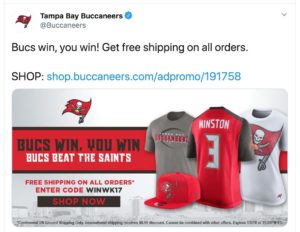 A good example of a simple giveaway contest is the #buckswinyouwin campaign by the Tampa Bay Buccaneers. Customers got free shipping if the Bucs won the game. Simple, clear, and very effective at creating conversation.
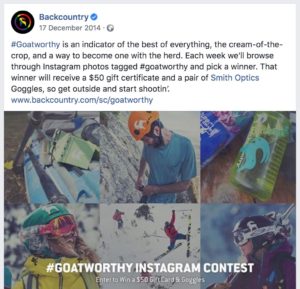 Some brands create campaigns so complex you need a degree to understand them. This Back Country campaign with the hashtag #goatworthy is hard to decipher unless you are an ardent fan of the brand. Make your giveaway campaign related to your brand offering while keeping it simple enough to garner user participation and user-generated content.
Investing in campaigns that generate user-generated content, such as comments and photo posts, is worth its weight in gold. It creates buzz and helps your brand shine through the platform algorithm.
Idea 4: Find a promotional partner
Forging partnerships can amplify your brand’s reach and inject fresh energy into your product lines. Aligning with lifestyle brands that share a similar ethos or target demographic opens your products to audiences you could not reach alone. A partnership between your fashion label and a sports brand could result in an athleisure line that appeals to fitness enthusiasts who also value high fashion.
Collaborating with artists is another powerful angle. Artists bring a creative perspective that can transform ordinary apparel into extraordinary art pieces. By partnering with popular local artists, you can create limited-edition collections that reflect local culture and current fashion trends, tapping into both the community’s pride and the artist’s following.
Partnerships with local businesses foster community and create cross-promotion opportunities. Collaborating with a local coffee shop to launch branded merchandise can attract both coffee lovers and fashion enthusiasts.
Idea 5: Work with micro-influencers
Micro-influencers, individuals with followers ranging from 1,000 to 100,000, tend to have higher engagement rates than celebrity influencers because their audiences view them as more relatable and trustworthy. It is like a friend recommending a product rather than a celebrity endorsement.
The key is selecting influencers whose values and aesthetics align closely with yours so their endorsements feel organic. Build long-term relationships rather than running one-off campaigns. A genuine partnership where the influencer becomes a true ambassador for your brand is worth far more than a single sponsored post.
Denim partnered with Jenn Im, who has over 2.7 million followers on YouTube, to create a video on their diverse line of denim jackets. With almost half a million views, the video works as an advertisement disguised as fashion advice.
Free Download
Brand Consistency Checklist
A 27-point checklist to audit your brand across every touchpoint. Used by our team on real client projects.
Success! Check your email for the download link.
Instant PDF download. We'll also send branding tips -- unsubscribe anytime.
How to start a clothing brand
With over 25 years of brand building experience, I have worked with many clothing brands and helped them launch to success. Here is the practical walkthrough of the process.
Start with the brand value proposition
When the idea to launch a clothing brand takes hold of your imagination, the first step should be to think about the brand value proposition. It takes discipline not to jump ahead. Not having a clear idea of what your value proposition is will hugely influence the success of your brand and your bottom line.
The intersection of the garments you plan to offer and the target customer needs is the sweet spot. If you do not clearly define how your proposed clothing line would appeal to the market you target, the rest of the launch process becomes an uphill battle.
You have to ask the question: what will make your clothing line valuable? Your clothing line will not be successful if people do not understand why they should pay attention to your brand. Understanding what sets your brand apart from the competition is a crucial step that many startups either ignore or are not aware of and end up paying the price later.
Suppose you want to sell premium hats starting at $120. Your target market can find similar hats in stores starting at $50. You believe your hats deserve a premium because of the premium quality material and craftsmanship. If you simply launch and expect people to come buy your premium hats, it will not work. You cannot simply communicate “high quality” because all brands claim the same. You need a story that connects with your target audience and makes your hats appealing and desirable enough to justify the premium.
Pick the right brand name
For a clothing company, your brand name is an asset that can really help your brand make an impact. The best advice I can give is to put your personal preferences aside and pick a name that matches your core values, your brand value, and the worldview of your potential customers. Think ahead to how your brand name would be received. Ask yourself these key questions and make sure you understand the dos and don’ts of brand naming.
Once you pick a name, make sure it does not infringe on any copyright or trademark both locally and nationally. Check with your local chamber of commerce and conduct a federal trademark search with the USPTO database.
Consider the name “Lambeewear.” The client’s second name is Lambert and he decided to call his company Lambeewear, a stylish word that ties back to the owner in a very effective way. The first line of accessories Lambeewear launched were hats called “Lambeenies.” Now that is good branding.
Create the brand identity
Your brand needs a logo that matches its purpose and message. It is not all about aesthetics. The impact your logo and brand colors have on the target market is vital. Please do not ignore this part of your journey as the look and feel of your brand will decide how it is perceived by your target audience and ultimately drive sales and revenue. Read this to understand the difference between a simple logo design and branding.
Build your website and online store
Your website is the face of your brand. Every day I see companies with websites so poorly designed that I wonder what the stakeholders were thinking. When prospects visit your website, make sure you present your best face. Design standards are high these days and people are easily turned off by bad design. This is even more true if you are selling your clothing line online.
For a static website, you need at minimum an elegant custom design that matches your brand (never use free website builders), high quality royalty-free stock photos, professional photos of your products and garments (this single point can make or break your brand value), and a CMS so you can manage content yourself.
For an ecommerce store, go for a website and store that you own outright. Some online solutions host your store on their proprietary system, and if you decide to move later, you cannot easily take the store with you. Make sure the provider does not charge a percentage of all sales transactions, as this becomes a killer as sales grow. Sign up for a payment gateway with competitive rates. And make sure your store has social media integration so people share your products on the platforms that matter.
Set up social media
As a clothing and fashion company, social media is your best friend. Without a well-thought-out social media strategy and implementation, you are literally leaving money on the table. Social media works both directly and indirectly to convert prospects by generating traffic to your website and increasing brand engagement.
For a clothing line, Facebook, Instagram, and Pinterest are the major winners. Here are 5 simple rules for branding on Facebook. Also read my article on how to market a clothing brand on Instagram for strategies, tips, and tricks.
Get your pricing right
Pricing is the biggest challenge for most small businesses, especially for a clothing label. If you have established your brand value proposition clearly, you should be able to price your garments based on the value your clothing brings to customers. If the story is told right, you can charge premiums.
As a startup, it is very tempting to price low. When I talk about increasing prices, many clients balk and shake with fear because they look at pricing as arbitrary. Pricing depends on the value you create. If you do not make your clothing brand appealing or desirable, you have to participate in pricing wars. Instead focus on establishing a story that lifts your clothing line above the noise.
Your sales do not necessarily have to be tied to the price. Many business owners believe lower prices lead to more sales. This is true when dealing with a commodity like sugar or salt. But you have to raise your brand above commodity status. It has been proven that if done with the right context, raising prices and charging a premium actually increases sales.
A clothing brand that we helped create and launch approached the market by being an exclusive members-only club. Even before the launch, invites were sent to leading social media elite and media personalities along with five invites to give away. A couple of months before launch, the invites were at a premium and people were begging to get in. The premise: fashionable clothes for gentlemen created as limited editions, available only to members of the club. Google used this same formula when it launched Google+.
Always think about profit margins
I have worked with more than 200 brands in the past five years, and the single defining thing I have noticed is that business owners are not really tuned into how profit works. They tend to look at revenues and cash flow and enter a rat race to generate more revenue without proper consideration of profit margins.
Every business needs profits to sustain and grow. Large revenues with low profits keep businesses vulnerable. Without healthy profits, there is no money to invest back into improving the process, product quality, or infrastructure. Always make sure every garment or accessory you sell has a healthy margin, but do not consume profits for personal lifestyle. Have discipline in paying yourself just enough to sustain, at least initially. Always be thinking of profit margins.
I have seen many entrepreneurs who have launched clothing brands get some measure of success and then go spending money on fancy homes, vacations, and personal expenses, only to find that when sales decrease or the target market changes, they are left with an unhealthy brand that suffers and sometimes simply dies.
If you are ready to launch or relaunch your clothing brand, let’s talk. We have built brand identities for fashion labels across dozens of markets, from Indian luxury fashion to preppy clothing labels to designer swimwear. Explore our full portfolio to see the range.

Mash Bonigala
Creative Director & Brand Strategist
With 25+ years of building brands all around the world, Mash brings a keen insight and strategic thought process to the science of brand building. He has created brand strategies and competitive positioning stories that translate into powerful and stunning visual identities for all sizes of companies.
Featured Work
See Our Work in Action
Real brands, real results. Explore how we've helped businesses transform their identity.

Client Love
What Our Clients Say
Don't just take our word for it. Hear from the brands we've worked with.

Gracienne Myers
Banana Vital
"If you are looking for a company to design your company’s identity or even rebrand your current brand, Spellbrand is the company that you would choose, they designed my company, Banana Vital’s logo, and provided me with 6 design to choose from which made it hard to choose because they were all very good. Just recently I hired them to rebrand Mechanical Bull Sales and again every logo was great and well thought out. I am very pleased with the work that Spellbrand has provided and I am looking for to continue working with them."

Raymond Chen
RLC Global Archicom, Singapore
"SpellBrand was very accommodating from the beginning of the design process even when we had distinct design ideas, being architect designers ourselves. Jeff responded with many preliminary style options based on our initial sketchy ideas, enabling us to zoom in on the specific feel we were looking for. From that point on, it was just refinement and the final logo was in our hands in a matter of days. We have used SpellBrand on other logos for my clients projects."
Related Services You Might Love
Based on what you just read, here are services that can help you achieve similar results for your brand.
Free Download
Brand Consistency Checklist
A 27-point checklist to audit your brand across every touchpoint. Used by our team on real client projects.
Success! Check your email for the download link.
Instant PDF download. We'll also send branding tips -- unsubscribe anytime.
Keep Reading
Related Articles

Mar 23, 2026
Brand Collateral Design: How to Build a Cohesive System That Reinforces Your Brand at Every Touchpoint
How to design brand collateral as a system rather than a series of one-off projects. Covers business cards, packaging, digital assets, and building a scalable brand collateral system.
Read More
Mar 21, 2026
Brand Identity System: The Complete Guide to Building a Memorable Brand
How to build a brand identity system from strategy through logo, color palette, typography, and brand guidelines. The framework we use with every client at Spellbrand.
Read More
Mar 21, 2026
Customer Personas, Buyer Avatars & ICP: The Complete Guide
How we used ideal customer profiling to rebuild Spellbrand after losing 95% of revenue. The frameworks for buyer personas, customer avatars, and ICPs that work in practice.
Read More