

Spellbrand Blog
How To Win Over Your Audience With Your Brand Persona

The brand persona is a critical component of your overall brand strategy and is vitally important in making human connections with your audience. This persona has to align with your audience persona. If you want your brand to connect with the people who will keep making it a success, the persona is a priority.
Brand persona is the third pillar of our 5 Pillar Brand Strategy Blueprint. The first pillar was the ideal customer profile, and the second was the brand essence.
There are three elements in this section, and they each play a role in helping create your brand persona. It should go without saying that anytime someone interacts with your company, they should walk away feeling good about the experience.
This pillar is crucial to give the brand a distinct personality and a recognizable and meaningful voice and tone.
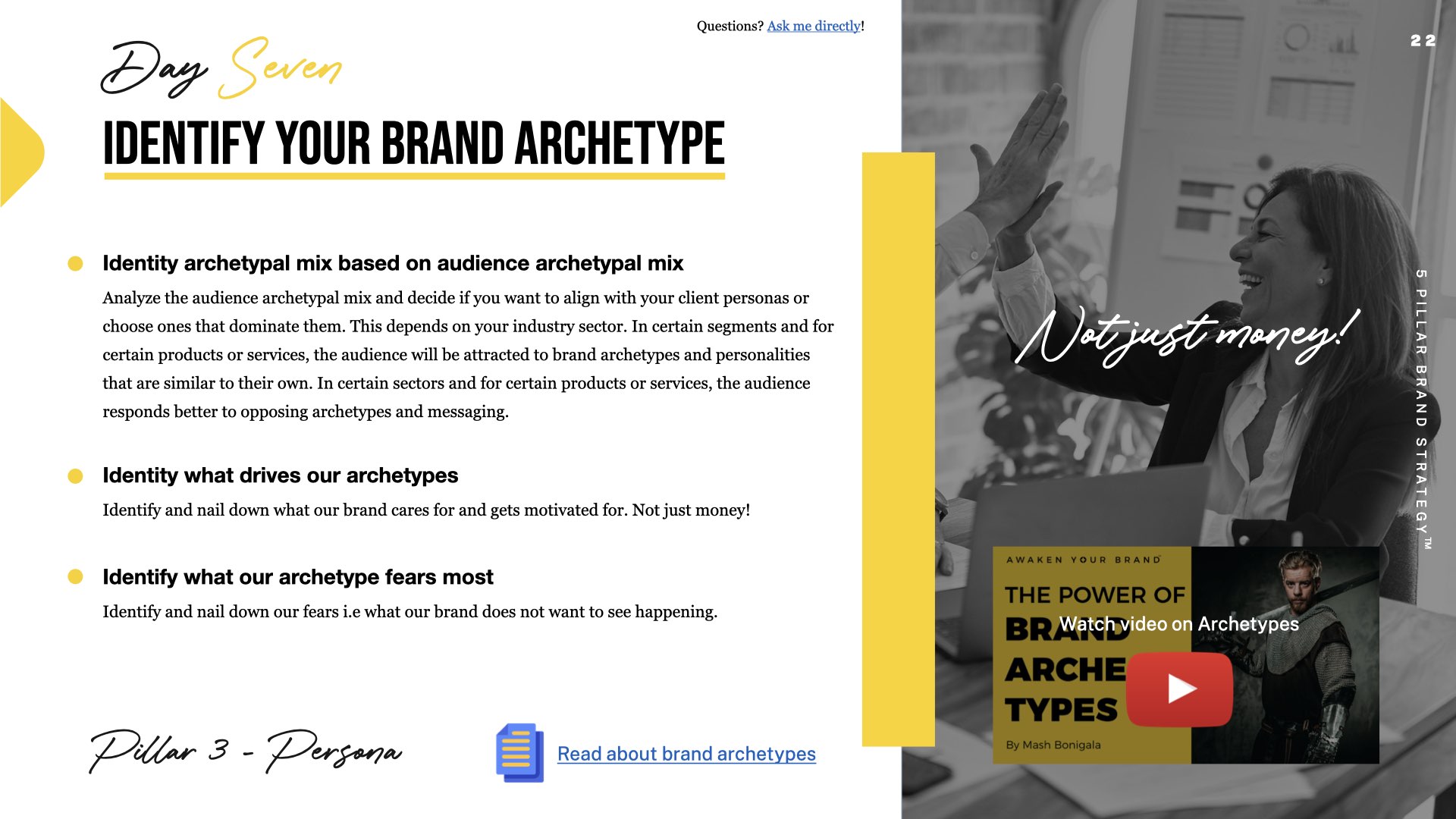
Identify your brand archetype
Just like your ICP, your brand too needs to have an archetype or an archetypal mix associated with its personality.
An archetype will help define specific characteristics of your brand that are based on the psychology of your audience, and this enables you to come up with strategies and messaging that align with your audience.
Identify the archetypal mix based on audience
Analyze the audience archetypal mix and decide if you want to align with those personas or choose ones that dominate them.
This depends on your industry sector. In specific segments and for certain products or services, the audience will be attracted to brand archetypes and personality that is similar to their own. In other sectors, the audience responds better to opposing archetypes and messaging.
Identify what drives your archetypes
Identify and nail down what your brand cares for and gets motivated by. At the root of all human behavior is the concept of motivation. The same should be applied to your brand.
What does your brand really care about? Beyond making money. How is that related to your product or service? How is it related to your audience and what they care about? Ideally, you would like to align this with your audience so your brand can enter their worldview.
Identify what your archetype fears most
Identify and nail down your fears: what your brand does not want to see happening. Just like people, your brand needs to fear certain things that go against your core values, your purpose, or your motivation.
The reason is simple. If your brand fears certain ideas or actions that erode your core essence, your strategies and tactics would be safe from indulging in those ideas or actions.
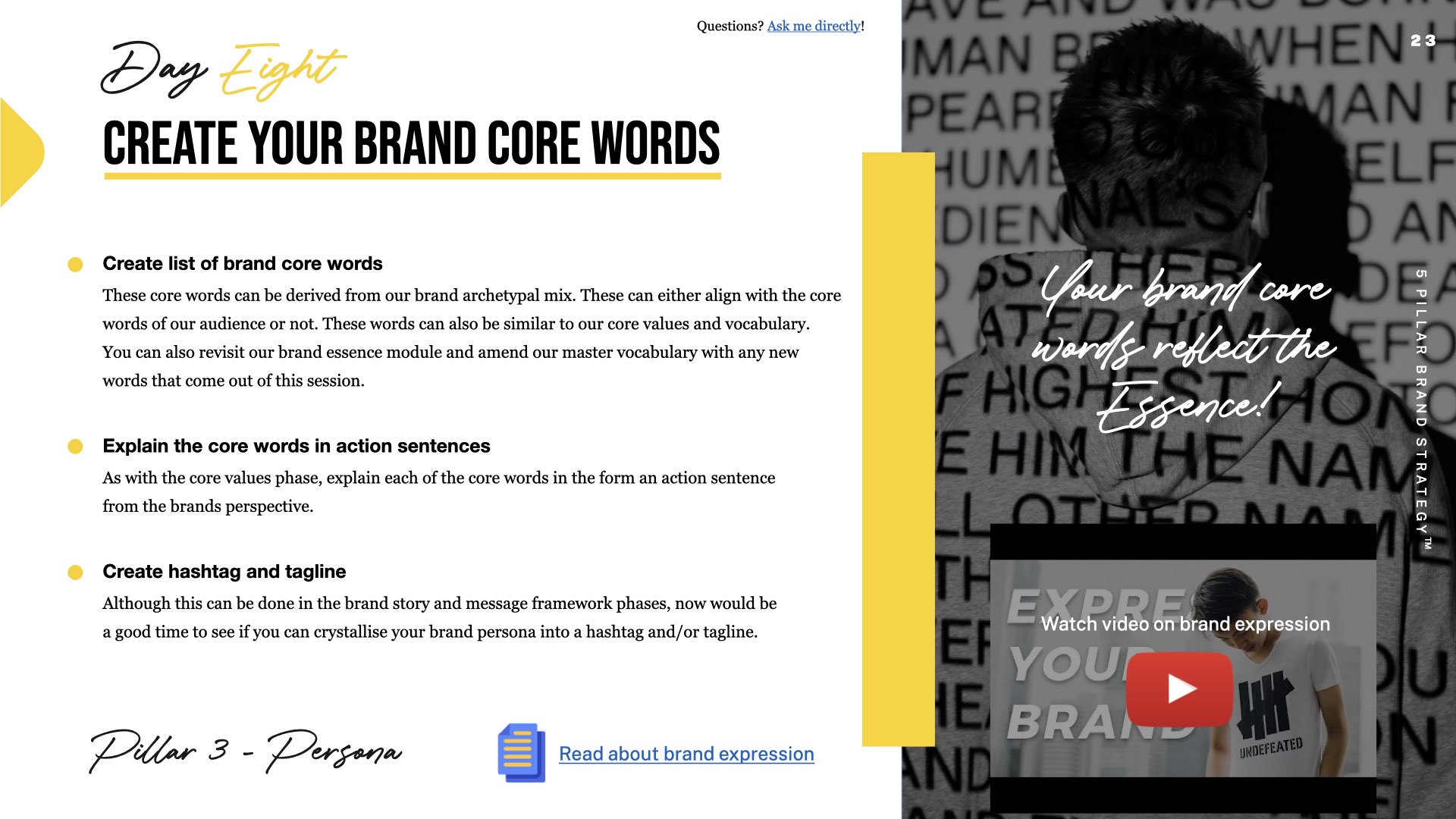
Create your brand core words and vocabulary
Just like language is essential for civilization, the words used for brand thinking determine the sophistication of the brand message and how the audience would perceive it.
Creating a set of core words describing the brand’s characteristics, beliefs, desires, and fears will help you articulate your brand.
Create a list of brand core words
These core words can be derived from your brand archetype mix and can either align with the core words of your audience or be in opposition. These words can also be similar to your core values and vocabulary.
You can also revisit your brand essence module and amend your master vocabulary with any new words from this session.
Explain the core words in action sentences
As with the core values phase, explain each of the core words in the form of an action sentence from the brand’s perspective.
For example, if one of your core words is determination, you can say, “the brand moves forward with determination in the face of adversity.” This puts the word into context.
When creating action sentences, do not worry too much about continuity or cohesiveness. These sentences can be isolated and not related to each other. They also do not have to be marketing-based and are usually not meant for the public.
Create hashtag and tagline
Although this can be done in the brand story and message framework phases, now would be an excellent time to see if you can crystallize your brand persona into a hashtag or tagline.
It is a good idea to start thinking about the hashtag at this stage because when you are creating action sentences, you may uncover a motif that works well as a tagline or rallying cry.
Remember, the whole process of brand positioning, strategy, and messaging framework is iterative and interlinked. You would go backwards to the essence phase or forward to the message phase, tweaking as you uncover new information and insights.
Create your brand voice and tone
Once you have identified the archetypal mix and created your brand vocabulary, you will have plenty of insights into your brand’s personality.
In this task, you start to lay down the brand voice and tone: how it sounds, looks, and feels to the audience.
However, remember that this personality framework is not 100% set in stone. Voice and tone can change and adapt to different media, campaigns, and contexts.
Identify the brand personality approach
Jennifer Acker published a personality framework in 1997 in which she proposed five personality dimensions that can be applied to brands: sincerity, excitement, competence, sophistication, and ruggedness.
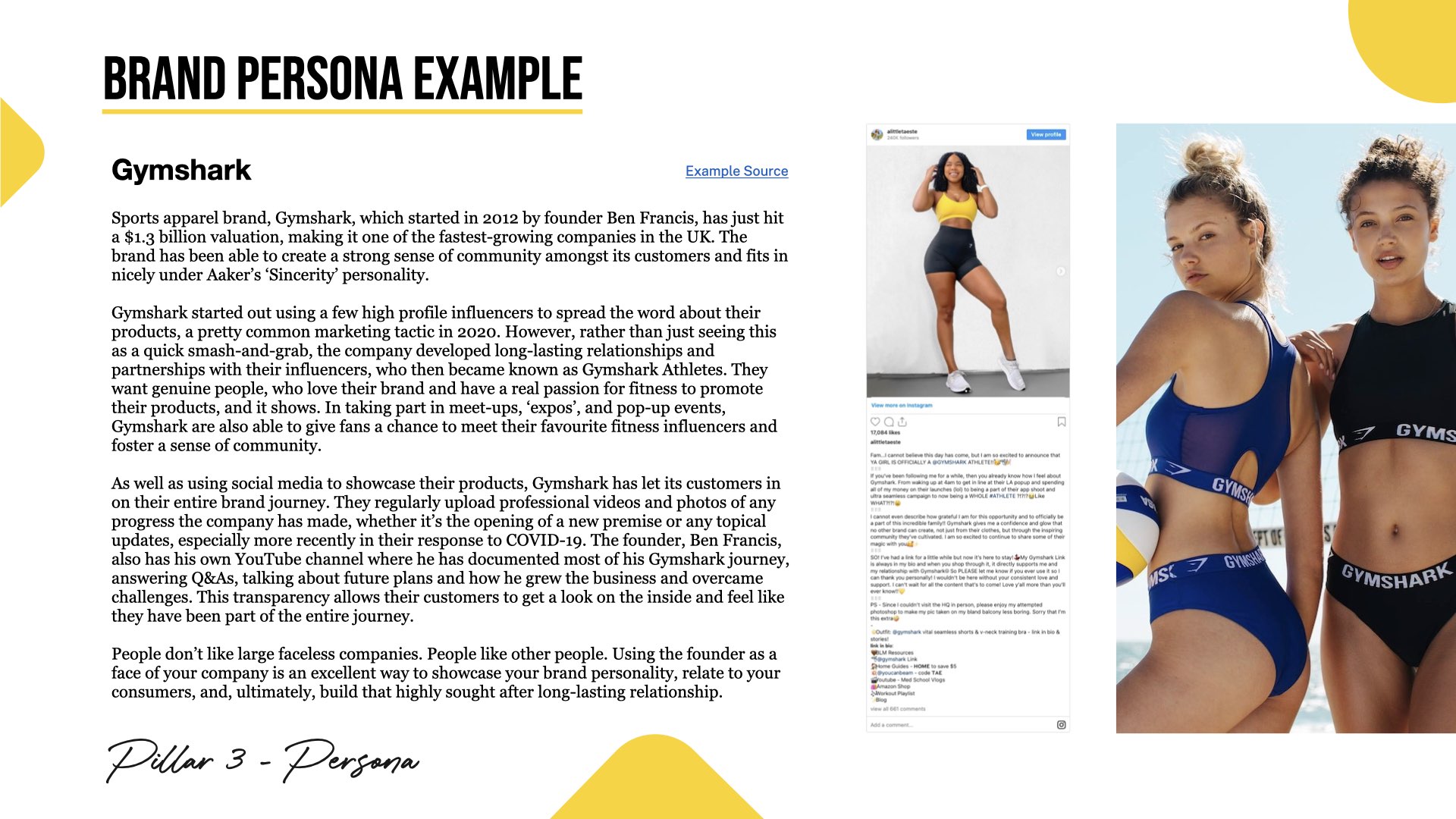
Sincere brands are honest, grounded, transparent, and trustful. They typically focus on quality, legacy, and trust. A great example is Patagonia, which has built up a personality of trust and care for the environment. Their Worn Wear program says it all: “One of the most responsible things we can do as a company is make high-quality stuff that lasts for years, so you don’t have to buy more of it. Buying a used garment extends its life on average by 2.2 years, which reduces its carbon, waste and water footprint by 73%.”
Companies that exhibit imagination, cutting edge inspiration, and even edginess fall into the excitement dimension. Red Bull is the textbook example. One look at their branding, advertising, or product claims, and you see excitement oozing out. They sponsor extreme sporting events full of exhilaration and broadcast their personality through those events.
Brands that show reliability, responsibility, efficiency, and intelligence demonstrate competence. Apple is the standout here. People associate reliability and intelligence with anything Apple does or produces. Although innovation is at the essence of Apple, the messaging and personality these days tend to be more about competence than simply innovation.
Brands that exude glamour, luxury, pomp, and class show sophisticated personalities, often embodying the Ruler archetype or Lover archetype. Gucci is at the top of the luxury brand game and prices their products so high that they are not affordable to most people. They couple that with the glamour and romance of luxury to pull off complete sophistication.
Brands that seem tough, masculine, and outdoorsy usually have ruggedness as their personality dimension, often aligning with the Rebel archetype or Hero archetype, and tend to attract a predominantly male audience. Jeep is a perfect example, with products, branding, and messaging that all push the rugged nature of its character.
Create the brand personality
Once you decide which personality dimension most suits your brand based on the archetypal mix, it is time to lay down specific characteristics you want your brand to exhibit and own.
Start with beliefs and opinions. This makes your brand more human. Your brand should have opinions on things that relate to your audience and your market segment. Do not be shy or afraid. Of course, ensure you are not taking extremist views or rubbing your audience the wrong way. That is why it helps to create those wafer-thin audience ICPs.
Next, figure out the attitude of the brand. This will show itself as the voice and tone of the brand. Within the context of the personality dimension, determine what attitude you would like to show.
Write down a detailed description of how you want your brand to behave in different situations and scenarios, such as when onboarding customers, dealing with complaints, and so on. Your brand personality then becomes a guide for every interaction.
Understand how to manifest your brand personality
To help you understand how a brand persona manifests in the real world, search for and identify big brand adverts that align with your personality. Search on YouTube for videos of adverts that convey the brand personality you are going for. This is not an easy task, but with patience and time, you can find good videos that relate to your brand personality.
Study these to see how big brands showcase their brand personality. Just as a guide.
Ready to build a brand persona that connects? Download our free 5 Pillar Brand Strategy Blueprint to build a strong brand, or get in touch to discuss your brand’s personality.

Mash Bonigala
Creative Director & Brand Strategist
With 25+ years of building brands all around the world, Mash brings a keen insight and strategic thought process to the science of brand building. He has created brand strategies and competitive positioning stories that translate into powerful and stunning visual identities for all sizes of companies.
Featured Work
See Our Work in Action
Real brands, real results. Explore how we've helped businesses transform their identity.

Client Love
What Our Clients Say
Don't just take our word for it. Hear from the brands we've worked with.

Joe Russell
VALENSOR
"Mash and his team were amazing. They were able to take our vision and produce a truly creative and unique branding package. What struck me most was their desire to make our company happy alongside ensuring our company has good branding. Mash was always willing to answer our questions and help us arrive at a decision. Overall, SpellBrand is not just creating company names and logos, they are creating character and soul for their clients' companies. I would recommend them to anyone looking to stand-out among their competitors. SpellBrand services are most definitely worth their weight in gold."

Jenny Richard
Woods Of Fairfax
"Working with the team at Spellbrand has been fantastic! I spent time researching companies that would help me build brands for each asset that are all in different locations and more specifically build a brand that could help tell each of their unique stories. Spellbrand did just that. The process was easy. To provide them with my initial thoughts through a nicely-outlined input form they sent to me and they took that information and created a number of awesome designs. I was able to incorporate "the story" easily with a design we selected. I'm excited to get it into action and see what's in store for the next project. Also, each person I worked with has been super responsive, knowledgeable, and awesome to work with! Kudos to Mash, Mike, and Eva! I really enjoy working with you!"
Related Services You Might Love
Based on what you just read, here are services that can help you achieve similar results for your brand.
Free Download
Brand Consistency Checklist
A 27-point checklist to audit your brand across every touchpoint. Used by our team on real client projects.
Success! Check your email for the download link.
Instant PDF download. We'll also send branding tips -- unsubscribe anytime.
Keep Reading
Related Articles

Mar 23, 2026
Brand Collateral Design: How to Build a Cohesive System That Reinforces Your Brand at Every Touchpoint
How to design brand collateral as a system rather than a series of one-off projects. Covers business cards, packaging, digital assets, and building a scalable brand collateral system.
Read More
Mar 21, 2026
Brand Identity System: The Complete Guide to Building a Memorable Brand
How to build a brand identity system from strategy through logo, color palette, typography, and brand guidelines. The framework we use with every client at Spellbrand.
Read More
Mar 19, 2026
Brand Identity Design: The Strategic Process Behind Visual Identities That Command Markets
Brand identity design is more than logos and color palettes. The complete process for building a visual identity system that differentiates, builds trust, and scales.
Read More